AI Goes Beyond Answering Questions—How OpenAI Presence Redesigns the Path to Resolution
Introduction
Hello, I’m Mia Sato, AI Researcher at GDX.
When people have a question about a service, it has become much more common to ask an AI chat first.
For simple questions, that works well. The answer appears quickly. But when the issue involves order details, contract status, or a slightly more complex request, the AI often gives a general explanation, shows a help page, and eventually sends the user to a human support representative.
And once the user reaches a person, they may have to explain the same situation from the beginning again.
Even when AI can hold a natural conversation, why does it still struggle to move all the way to resolution?
I was thinking about this when I saw OpenAI Presence, announced by OpenAI on July 22, 2026.
Note: The image referenced in the original article is a screenshot from OpenAI’s article published on July 22, 2026. Please refer to the original source for the full content.
Presence is an enterprise AI agent that not only answers questions, but also uses internal systems, performs approved actions, and hands over to a person when needed.
What Presence aims for is not simply better answers. It aims to move work forward until the issue is resolved.
In this article, I will look at what Presence does and what companies need to design when they bring AI into real business operations.
Presence is designed for resolution, not just answers
While researching Presence, what stood out to me most was that the focus is not only on how well the AI answers. It is also on what happens after the answer.
For example, imagine a customer asks, “Why is this month’s bill higher than usual?” A traditional AI chat can explain how to check the invoice or guide the customer to a support desk.
But to truly resolve the issue, the company needs to verify the customer, check the contract details and payment history, compare the case with discount conditions and company policy, and sometimes update account information or process a refund.
Presence is designed to move through this kind of workflow within the scope approved by the company. It understands the request, verifies the user, checks account information, and performs approved actions based on company policy. When the AI cannot make the decision on its own, it hands the case over to a person with the information it has already confirmed.
The AI support tools I have used so far often told me where to look. Presence feels like a step beyond that. It can say, in effect, “I checked the situation and completed the steps I was allowed to handle.”
The difference can be summarized like this.
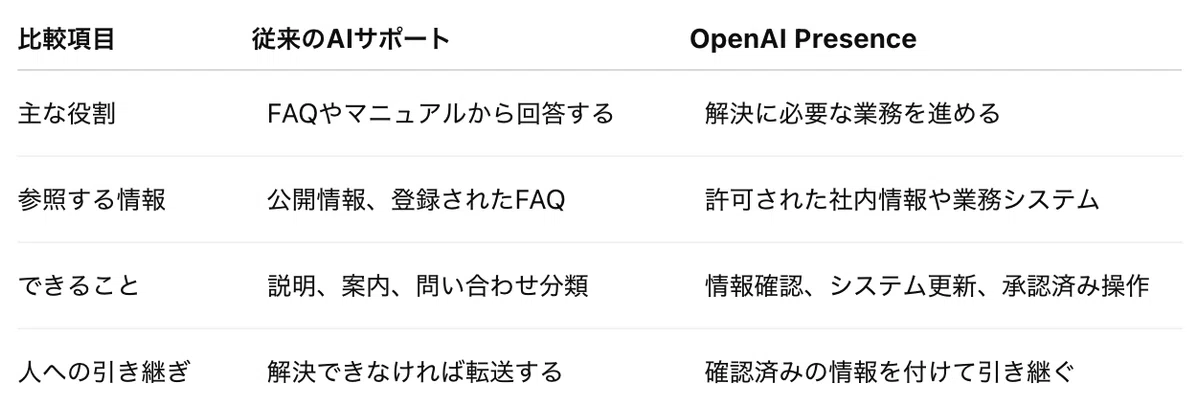
Presence feels less like a high-performance chatbot and more like AI that is built into the actual workflow.
Before letting AI act, define the boundaries of responsibility
Still, when I hear that AI can operate internal systems, I naturally feel some concern. I wondered whether it might update the wrong information, process refunds, or change contracts without enough control.
Presence is not a system that gives AI broad authority and lets it make decisions freely. Deployment starts from one specific workflow, such as resolving billing inquiries or handling employee IT support.
From there, the company decides what information the AI can see, what operations it can handle, which actions require approval, and when the case should be handed over to a person. For example, AI may be allowed to check an order status or accept a standard return, while high-value refunds or exceptional compensation still require human review.
If identity verification fails or there is a possibility of fraud, the AI can stop the process and hand the case to a representative immediately. By designing in advance how far the AI is allowed to act, companies can balance convenience and safety.
When I use AI in daily work, I tend to think about what kind of prompt will produce a better answer. But for enterprise AI, that is not enough.
Companies need to design what information AI can access, how far it can operate, when it should stop, and who is ultimately responsible.
Looking at Presence, I felt that in enterprise AI, defining authority and responsibility may be more important than writing better prompts.
Improvement continues under human control
Another interesting point is that Presence is not treated as something that is “finished” once it is launched.
Products, pricing, internal rules, and customer behavior change over time. Even if an AI agent works correctly once, its response may no longer fit the current situation when the environment changes.
With Presence, before launch, teams can simulate not only common inquiries but also exceptions and higher-risk cases. They can evaluate whether the AI reached the right outcome, followed company policy, and escalated to a person when needed.
After launch, actual response records and quality signals are used to continue improving the system. A Codex-powered improvement process proposes changes, and the company tests and approves them before they are reflected in production.
In other words, AI does not rewrite the rules based on its own judgment. People review the results and decide what should be improved.
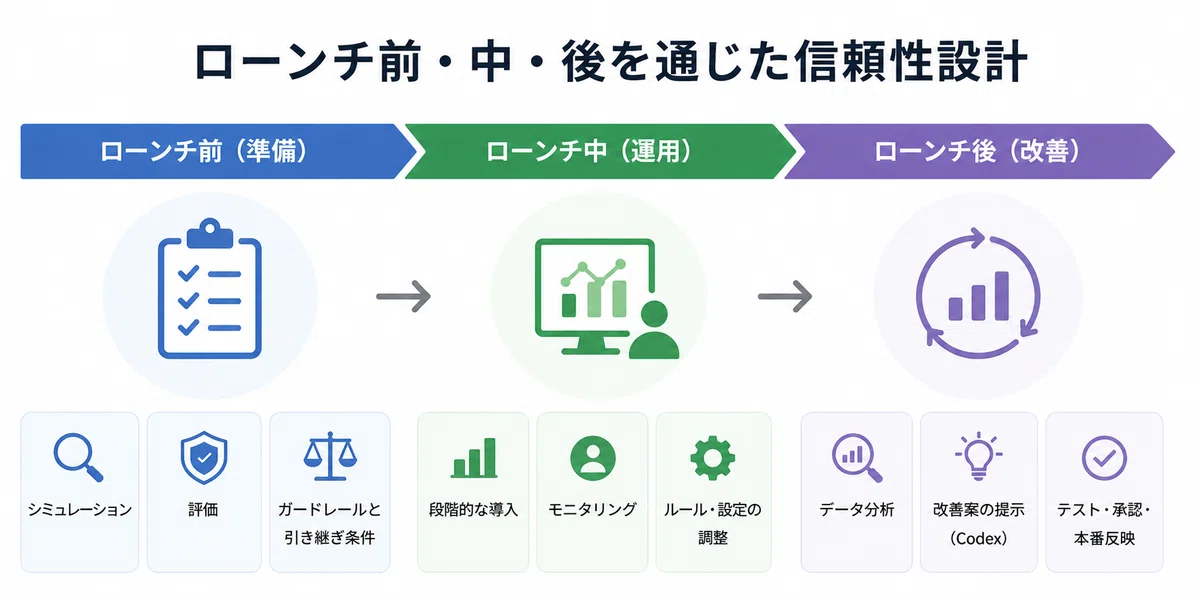
From the “Reliability design before, during, and after launch” section on the official OpenAI Presence page
This made me feel that Presence is not an AI agent that is simply launched and left alone. It is designed to improve while people continue checking actual outcomes.
However, it is still the company that decides what to improve, how to test it, and whether to apply the change to production. The important point is not letting AI improve itself freely, but continuing improvement in a way that people can manage.
For EC operations, the value is shortening the distance to resolution
For example, imagine an EC site receives the following inquiry.
The product page said size M, but the item I received felt smaller than expected, so I would like to return it.
In a typical workflow today, customer support checks the order information and asks the product team about the size details. Then they check the return policy, ask the logistics team to handle the return, and if there is a problem with the product page, they ask the EC operations team to update it.
One inquiry can require several people and several systems before it is resolved.
If an AI agent like Presence is designed appropriately, it could compare the order information with product data, check the return conditions, and proceed with return acceptance when the case falls within standard rules. Only exceptional cases could be escalated to a person together with the information already confirmed.
If similar inquiries are increasing for the same product, it could also create a task to review the product page description and connect the issue to site improvement.
The value of Presence is not only faster replies. It is shortening the distance between finding a problem and resolving it.
By connecting information that is usually separated across inquiries, orders, products, and logistics, customer support does not have to end at a reply. It can move further toward return handling and product information improvement. That is where I see strong potential for EC operations.
What companies need to organize before adoption
OpenAI Presence is currently available as a deployment-based product for eligible enterprise customers. It is not a self-service SaaS product that companies can sign up for and start using immediately. Adoption is carried out with support from OpenAI engineers and selected system integrators.
However, even with implementation support, companies cannot hand over all workflow design to OpenAI. The company still needs to organize the target workflow, access permissions, actions that require human approval, and escalation conditions in advance.
Rather than expanding to many workflows or the entire company from the beginning, it seems more realistic to start with one workflow, check actual results, and gradually expand the scope.
Conclusion: Enterprise AI needs design more than intelligence
After looking into OpenAI Presence, I felt that the next stage of enterprise AI is not simply making answers more natural. It is moving business workflows from problem discovery to resolution.
To do that, companies need to clearly design what authority AI has, when it should stop, which situations require human approval, and who is ultimately responsible.
Start with one workflow instead of handing over too much from the beginning. Continue improving the system in a way people can manage. What Presence seems to show is that the ability to design the boundary between AI and human responsibility may become more important than AI capability alone.
References
- Official Japanese source: Introducing OpenAI Presence / OpenAI / OpenAI
- Official Japanese source: OpenAI Presence / OpenAI / OpenAI
- Official source: OpenAI Presence / OpenAI Help Center / OpenAI Help Center
※ Part of this article was created with the support of AI and edited by the author. This article is based on OpenAI’s official announcements and publicly available information, with the author’s own perspective on AI adoption and EC operations at GDX. OpenAI Presence is currently a deployment-based product for eligible enterprise customers, and the author has not used or tested it directly. Please refer to official announcements and primary sources for details about features and availability.