What Makes a Product AI-Ready? — How E-Commerce Teams Should Structure Product Data for the Age of AI Shopping
Introduction
Hello, I’m Mia Sato, AI Researcher at GDX.
Until recently, when people looked for products online, the usual flow was to enter search keywords, open several product pages, and compare them one by one. But that search behavior is beginning to change.
For example, if you tell AI, “I’m looking for a black bag under 20,000 yen that works for both business trips and travel, and can fit a 13-inch laptop,” it can organize the conditions and compare possible options.
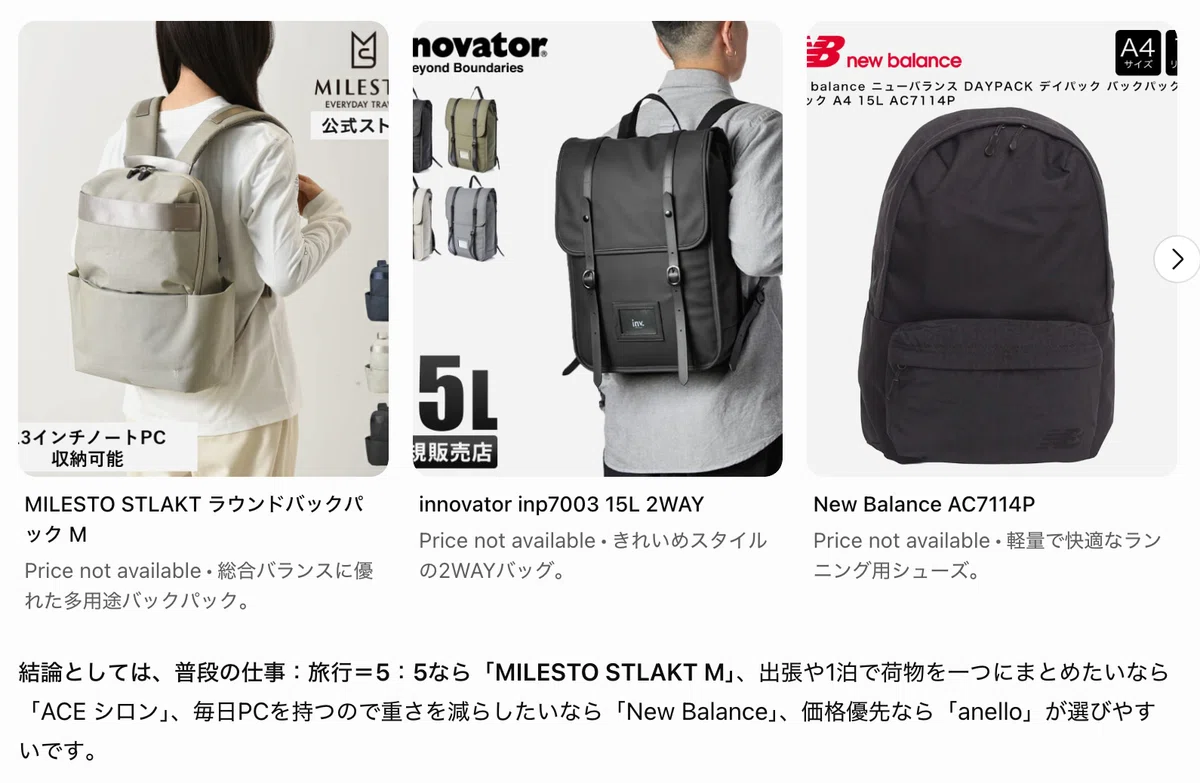
An example of asking ChatGPT to compare products based on multiple conditions.
As someone involved in EC operations, one question came to mind.
“What does AI look at when it chooses a product?”
If there are more situations where AI searches for products on behalf of customers, product pages need to communicate not only to people, but also to AI.
More specifically, AI needs enough information to correctly understand a product’s features and conditions. If AI cannot judge the product accurately, it will be difficult for that product to appear as a candidate.
In that sense, being “correctly understood” may become the starting point for being selected by AI.
In this article, I will look at how EC teams can review product data from that perspective.
From being searched to being found through conditions
While trying AI-based product search, the biggest change I noticed was that users no longer have to carefully convert their needs into search keywords.
In the past, a user might have searched for keywords such as “lightweight bag waterproof commuting.” With AI, the same person can naturally say, “I want a lightweight bag that works on rainy days and still looks good for work.”
Looking at this difference, I felt that EC teams may need to look at product information not only from the perspective of “What keywords will people search for?” but also “What conditions and usage scenes will customers tell AI about?”
Product data becomes material for explaining products to AI
This led me to look into Product Feeds, which OpenAI provides information about for merchants.
Product feeds use information that EC teams already manage, such as product names, descriptions, images, prices, and availability, for product discovery.
Seeing this changed how I think about product data. Until now, I often saw it mainly as information for publishing and management. But when AI starts helping users find products, the same data also becomes material for judging whether a product matches a condition, whether it can be bought now, and which exact product it is.
Product identifiers such as brand names, model numbers, JAN codes, and GTINs can also help AI identify products accurately.
And if users consult AI by describing usage scenes, it may become important for product information on the web to explain who the product is for and in what situations it is useful.
So rather than creating entirely new information just for AI, I think the more practical first step is to review existing product data and content from the perspective of whether AI can understand it correctly and connect it to the user’s purpose.
Three things to review for AI-based product discovery
1. Do not rely only on vague expressions
Product descriptions often use expressions such as “lightweight,” “wide fit,” or “easy to use on rainy days.”
These phrases are easy for people to understand, but they may not be enough when AI needs to judge specific conditions.
So I tried a simple test.
First, I used slightly vague expressions such as “lightweight” and “relaxed fit.”
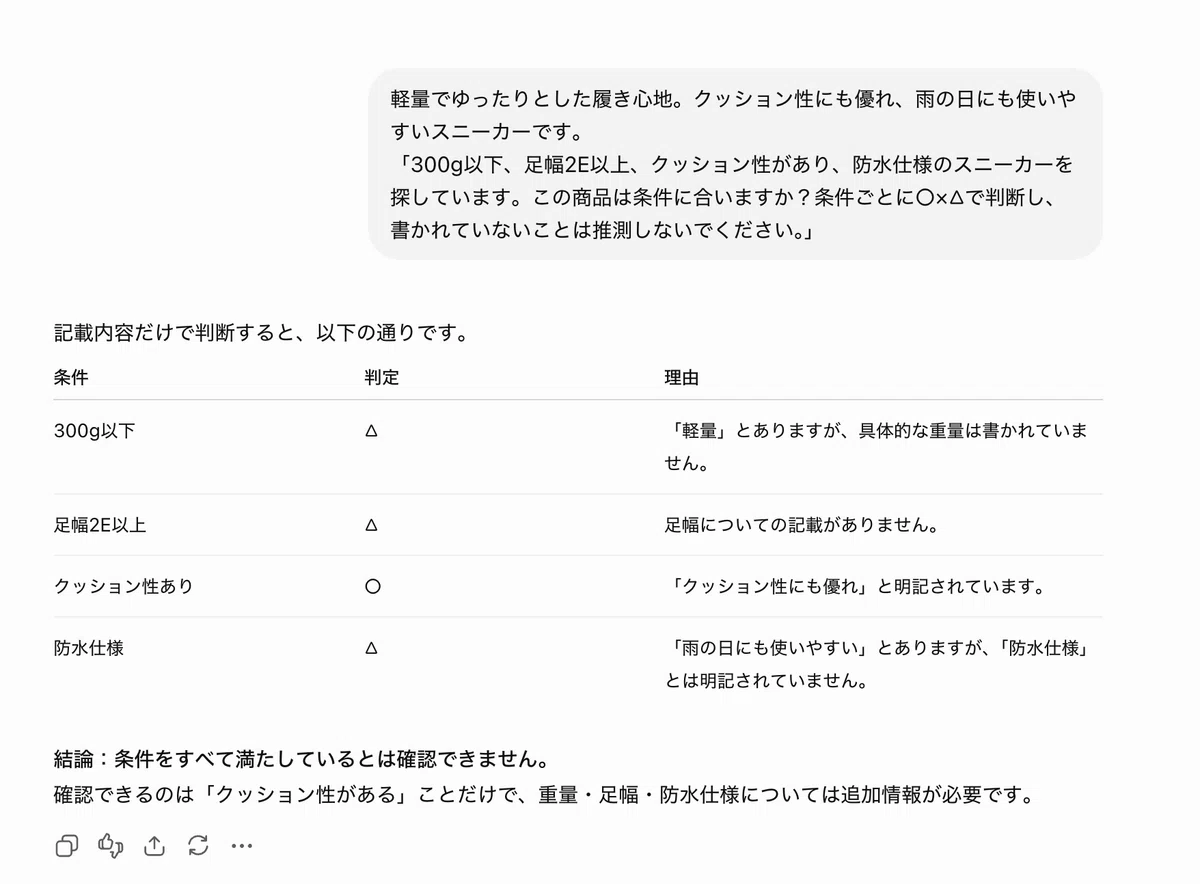
With only expressions such as “lightweight” and “relaxed fit,” AI could not judge specific conditions such as weight or shoe width.
Then I added more specific information, such as weight and foot width.
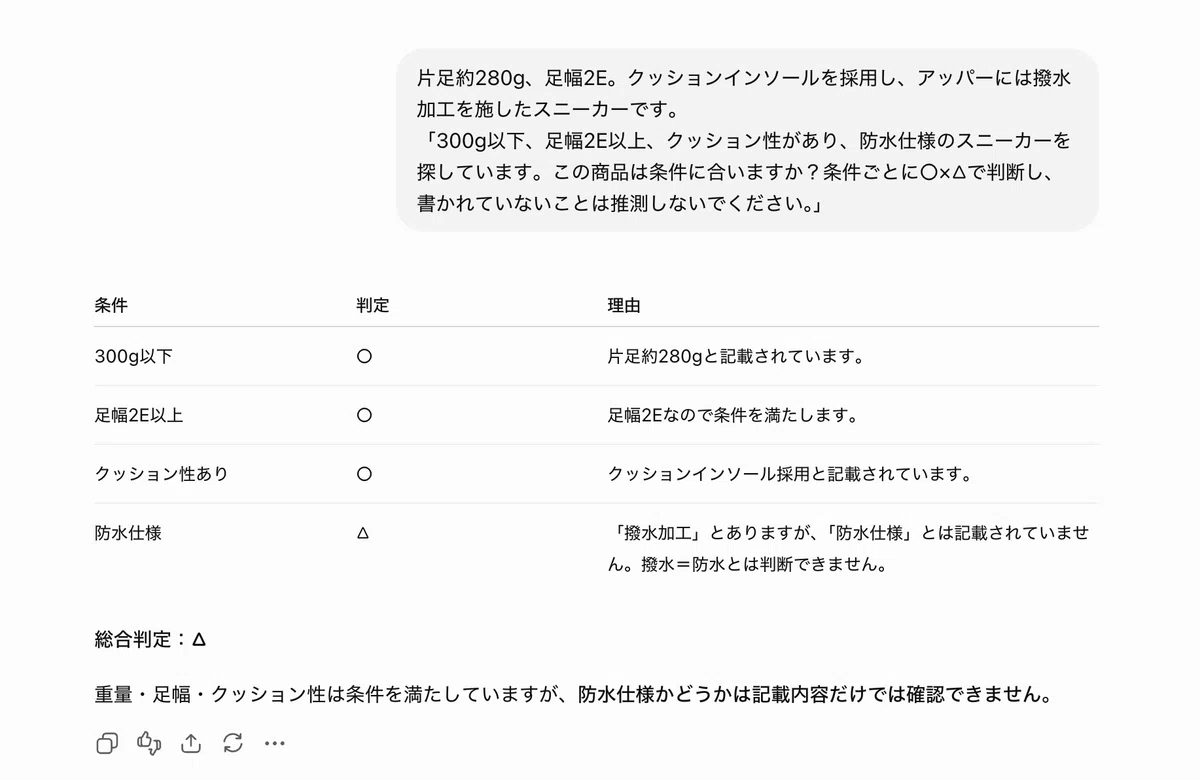
When the description included “about 280g per shoe” and “2E width,” AI could judge weight and width. However, water-repellent and waterproof are different, so it did not treat the product as waterproof.
What I found interesting was that “being understandable” and “being judged as meeting a condition” are not the same thing.
There is no need to remove expressions like “lightweight.” But it helps to place a concrete basis next to them, such as “about 280g.” Rather than making descriptions longer, it may be more important to include information that does not force AI to guess.
2. Keep “available now” information accurate
The next point I thought about was the current sales status: price, stock, size, color, and variations.
Even if a product matches the user’s conditions, it will not be a good recommendation if the desired size is sold out or the listed price does not match the actual price.
Thinking about this, I felt that the AI era does not necessarily require a completely special new operation. Rather, the accuracy of basic EC operations that teams have already been doing may become even more important.
Price updates, inventory synchronization, and size and color variation management are not new tasks.
But when AI supports product discovery, it becomes important to communicate not only whether a product matches the conditions, but also whether it can truly be purchased now under those conditions.
3. Explain who it is for and when it is useful
Another point I thought about is whether AI can really judge that a product fits a person based only on specifications.
Users do not always express what they want as a specification, such as “I want a waterproof backpack.”
They may ask AI from the perspective of a situation or problem, such as “I do not want my laptop to get wet during my rainy commute.”
From that perspective, it may become important to communicate not only specifications such as “waterproof,” but also who the product is suited for, where it is useful, and what kind of problem it helps solve.
Instead of only saying “uses waterproof material,” a description such as “easy to carry a laptop on rainy commuting days” gives AI a clue to connect the user’s request with the product.
This is not limited to product descriptions. It also connects to FAQs, feature pages, and other content across the website.
Through this article, I felt that in addition to accurately communicating product features, it will become important to explain how those features help specific people in specific situations.
Being selected by AI is not a special AI tactic
After looking into this topic, I do not think the answer is to add special keywords just for AI.
What we need to review is more basic.
Is there concrete information that AI can judge?
Do price and stock reflect the current sales status?
Does the product information explain who the product is useful for and in what situation?
Until now, EC teams may have looked at product information mainly from the perspective of what should be shown on the product page.
From now on, it may also be worth asking whether AI can judge the product correctly and connect it with the user’s usage scene.
This connects to product descriptions, usage scene presentation, and content design.
Rather than writing special text for AI, the idea is to leave the product’s existing value on the web in a form that AI can also read. That is closer to how I see it.
Conclusion
While looking into AI shopping and product data, I felt that being “selected by AI” is not simply about increasing the amount of product information.
First, AI needs to be able to correctly judge the product based on information such as weight, size, price, and availability.
Then, the product’s features need to connect to who it helps and in what situation.
Only then can the user’s request to AI and the product be connected, creating the possibility that the product will be selected as a candidate.
For me, the key flow is:
Correctly understood → Connected to a usage scene → Selected as a candidate
That is what I felt is most important when thinking about products that AI can choose.
So instead of creating product data for AI from scratch, it may be better to start by reviewing the product information we already have.
Can AI judge it correctly?
Does it explain who the product helps and in what situation?
For EC teams, that seems like a realistic first step.
This is a theme I would like to continue following.
References
- Official: Product feeds – Agentic Commerce / OpenAI Developers / OpenAI Developers
- Official: Get Started – Agentic Commerce / OpenAI Developers / OpenAI Developers
- Official: Best practices – Agentic Commerce / OpenAI Developers / OpenAI Developers
- Official: Using shopping research in ChatGPT / OpenAI Help Center / OpenAI Help Center
- Official: Powering Product Discovery in ChatGPT / OpenAI / OpenAI
※ Part of this article was created with the support of AI and edited by the author. This article is based on OpenAI’s official announcements and publicly available information, with the author’s own perspective on AI adoption and EC operations. AI-mediated product discovery, comparison, purchasing experiences, and merchant product data integrations are still evolving. Please refer to official announcements and primary sources from OpenAI and each EC platform for details about features, supported regions, eligible merchants, and integration conditions.